Friday, October 3, 2014

week four, online search for scholarly articles

Search the Brock University library or the Internet (e.g., Google Scholar) for one article on each of the topics below.
  • The pros and cons of using learning outcomes.
  • Benefits and/or challenges of Prior Learning Assessment (PLAR).

week four activity sheet learner characterisitcs

Session 4 Activity Sheet: Learner Characteristics
Compile information about the learners who are likely to be in your audience. If you are not sure, then take into account the subject matter and organizational context.
Learner Characteristics
Implications for Curriculum
General
e.g. Gender


  • This course is not gender specific.
  • This course will be attended by adults. However, ages can range widely.
  • Educators should have post secondary education...presume that education level is high.
  • Learning styles may vary. Consider inventory at beginning of course. Develop curriculum and instructional design to meet the various needs of diverse learning styles.


Diversity
e.g. Culture


  • This course may have diverse cultural needs.
  • Cultures may include geographic culture as well as workplace cultures.
  • English presumed. However, there may be learners with some language barriers.
  •  Learners will have diverse backgrounds and personal issues.
  • Diverse needs regarding EI (Goleman, 1998) including handling relationships (especially important in group work) and ability to self-motivate.
  • Learners will have diverse personal styles which may get in the way of developing to the "norming" stage (Bens, 2005) Create norms with learners to avoid conflict.


Human Rights
e.g. Religion


  • The course could be attended by learners with diverse religious cultures. Accommodating for these could include considerations such as extensions or modifications of deadlines (ie: religious holiday falls on due date)
  • Learners could also require accommodations for disabilities.  


Wednesday, October 1, 2014

week four, learners and diversity

Learners who are new to the country have special needs. Their cultural backgrounds may be completely different than the domestic students and often are major barriers to learning. Accommodating these learners is important and understanding them is crucial.

I have a couple examples to share. The first is one that happened this past year in a course I was learning in. The prof used an example of Jack and Jill in an analogy. He said "everyone knows Jack and Jill" and quickly continued with his lesson. The fact was that everyone did not know Jack and Jill. There was one student that was new to our country and had no clue. Jack and |Jill made absolutely no sense to him. He identified himself, which has actually helped me to always remember to use examples that will be relevant to my learners. I felt poorly for him as he was blown off by the prof and left no better off at the end of it.

The second example is that of the Chinese student and cultural differences that can be of great importance. One of my colleagues teaches in a program that attracts many foreign student and her class is filled with many Chinese students. She found out that these students prefer to have their information shared with them before class so that they can figure it out beforehand and not be caught losing face if they are called upon to answer a question that they might not know the answer to. They will not raise their hand unless they are sure of the answer. Once she started to load the info into the learning management system for them to preview the participation in class was increased dramatically. Losing face is a major avoidance for the Chinese. This would be something that we would not think of in our culture. We encourage learning from our mistakes.

It is really important to design our courses for the learners who will take them. making the effort to design well means making the effort of knowing our audience. The general characteristics of domestic learners may not hold for international students.

C.

week four duty to accommodate

My own experience with accommodations is fairly limited although I have had some students who required accommodating. I currently have a student with learning disabilities who comes to class with a personal support worker and who will receive a modified credit for her work in my manicure and pedicure classes. Her worker will work with me to modify her assessments. This is the third student in seven years of running our program. I have also received instruction to accommodate students myself for a number of reasons, including obesity and mobility issues, inability to concentrate, difficulties with reading and writing and health issues.
I did do a course on teaching adults with disabilities through Humber College a few years back. It was extremely helpful in understanding my role. I am a college professor in my areas of expertise and not a psychologist who can determine disabilities nor am I a learning specialist for students with disabilities. Students must identify themselves to the college as they are adults and their learning plans from when they were in grade school does not follow them to the college level. Once they have identified themselves with the college, the learning specialists will make a plan and then let me know what the students need. I do not know what their diagnoses is and students do not need to divulge that to me as it is a matter of privacy.
We are required to accommodate to the best of our ability. The college has everything in place to help the students who need it. I have never had a semester without a student with an accommodation. Some write their tests outside of the classroom environment. Some need extra time to write. Some need extra time to get to class. They are all different. Once I am advised to accommodate, I do. 
We have had to make all written documents that are on the College Website accessible. We have devices available for note taking, Some students need to record the lectures. The list of potential accommodations could be lengthy.
As I develop my instruction, I do my best to appeal to the many learning styles and needs. I may use visual aids, written materials, videos, lectures, demonstrations and discussions all in one class as I did this morning. I figure that if I can mix it up them I will catch more attention from more learners. :)
The trick is not to be scattered and disjointed. The material should run smoothly and make sense.
I have not had a student with a visual impairment. It would be very difficult to teach them how to do the practical skills they need to succeed as an esthetician. However, I have had students with some hearing loss and I have made accommodations for them. Where they sit in the class, speaking directly to them, providing written materials and videos for them to review have all helped. 
C.
Week four learning styles inventory check in and anticipating the learners

Letter to Erin:
hey there! Just checking in to see how you are doing. I have been busy the last couple of days and just getting back at it. We are in the middle of session four now and I have noticed that you have not been in the forums. As your learning partner I am checking in :)
Hope everything is okay.
The first thing for this session is to discuss the learning inventory we were to find and do last week. My home computer is crashing...so I am working from my iPad for a few days until I can get a replacement. Bear with me :)
I did two inventories and had some differences in results. The Vark questionnaire scored me highest in kinesthetic learning with visual just behind it. The questionnaire from University of NC scored me highest in visual. So overall, I was placed as a visual learner. I would say that I learn best with multiple methods of instruction and study.
As far as how this will affect my curriculum design...I would say that I would make sure that there are a variety of pedagogical approaches within the design and that I, as a visual learner, do not get caught up in creating a lot  of visual aids and forget about the learners with other learner characteristics. 
Of course, knowing our learners is a key but while designing we can only presume and develop for the material more than the individuals who will actually be in the course. My feeling is that it is important to always leave room for tweaking to the individuals after designing. It. Is crucial to understand our learners. I do my best to achieve this by taking inventory and completing critical incident questionnaires in the early weeks of a course to help me to know if I am on track. (See Stephen Brookfield CIQ http://www.stephenbrookfield.com/Dr._Stephen_D._Brookfield/Critical_Incident_Questionnaire.html
So, I hope all is well and you are enjoying your evening. Keep in touch!
C.

Anticipating the learners

I figure that because my course is Technology for the Educator, my classroom will be filled with other educators from different areas of expertise and context of setting. In other classes I have taken I have educators from many areas including paramedics, banking, the OPP, different levels of academia etc...
Of course, educators have their own styles of learning and teaching. However, I think that educating educators would have it's own challenges. I believe that the level of critical thinking would be high and the willingness to learn as they explore new perspectives would be high as well. Using a tool such as the Critical Incident Questionnaire would be helpful. Asking the learners to weigh in on what they hope to achieve and how you are doing so far would facilitate knowing them and knowing if I am on track. Having the learners complete a learning styles inventory would also be helpful. Reflecting upon their styles will help them to identify what they need or how they will best learn. Potentially this will be a tool that they can use as they move forward with their own learners in their individual environments using their new online tools.
C. 

Friday, September 26, 2014

week three learning style

The first questionnaire was found at http://www.vark-learn.com/english/page.asp?p=questionnaire

The VARK Questionnaire Results 
Your scores were:
  • Visual: 8
  • Aural: 8
  • Read/Write: 5
  • Kinesthetic: 10
You have a multimodal (VARK) learning preference.
Use the following helpsheets for study strategies that apply to your learning preferences:
multimodal
visual
aural
read-write
kinesthetic

I did one other inventory at  https://www.engr.ncsu.edu/learningstyles/ilsweb.html

NC STATE UNIVERSITY

Learning Styles Results


      Results for: Carolyn Vandersluis


      ACT                      X                            REF
           11  9   7   5   3   1   1   3   5   7   9   11
                              <-- -->

      SEN                              X                    INT
           11  9   7   5   3   1   1   3   5   7   9   11
                              <-- -->

      VIS          X                                        VRB
           11  9   7   5   3   1   1   3   5   7   9   11
                              <-- -->

      SEQ                          X                        GLO
           11  9   7   5   3   1   1   3   5   7   9   11
                              <-- -->


  • If your score on a scale is 1-3, you are fairly well balanced on the two dimensions of that scale.
  • If your score on a scale is 5-7, you have a moderate preference for one dimension of the scale and will learn more easily in a teaching environment which favors that dimension.
  • If your score on a scale is 9-11, you have a very strong preference for one dimension of the scale. You may have real difficulty learning in an environment which does not support that preference.
We suggest you print this page, so that when you look at the explanations of the different scales you will have a record of your individual preferences. When you close the page the information cannot be retrieved.For explanations of the scales and the implications of your preferences, click on
Learning Style Descriptions.
For more information about learning styles or to take the test again, click on
Learning Style Page.

week three text review

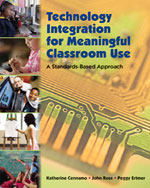
Not sure at this point if I wish to use a text for my course. I have in mind to develop my instructional materials using online resources. However, here is a list of sites that I could peruse for books. So far this is the book that may be most useful:

 Product Image

Technology Integration for Meaningful Classroom Use: A Standards-Based Approach, 1st Edition

  • Cennamo/Ross/Ertmer - ©2010
  • ISBN10: 0-495-09047-6
  • ISBN13: 978-0-495-09047-2

and here are the links to other options: